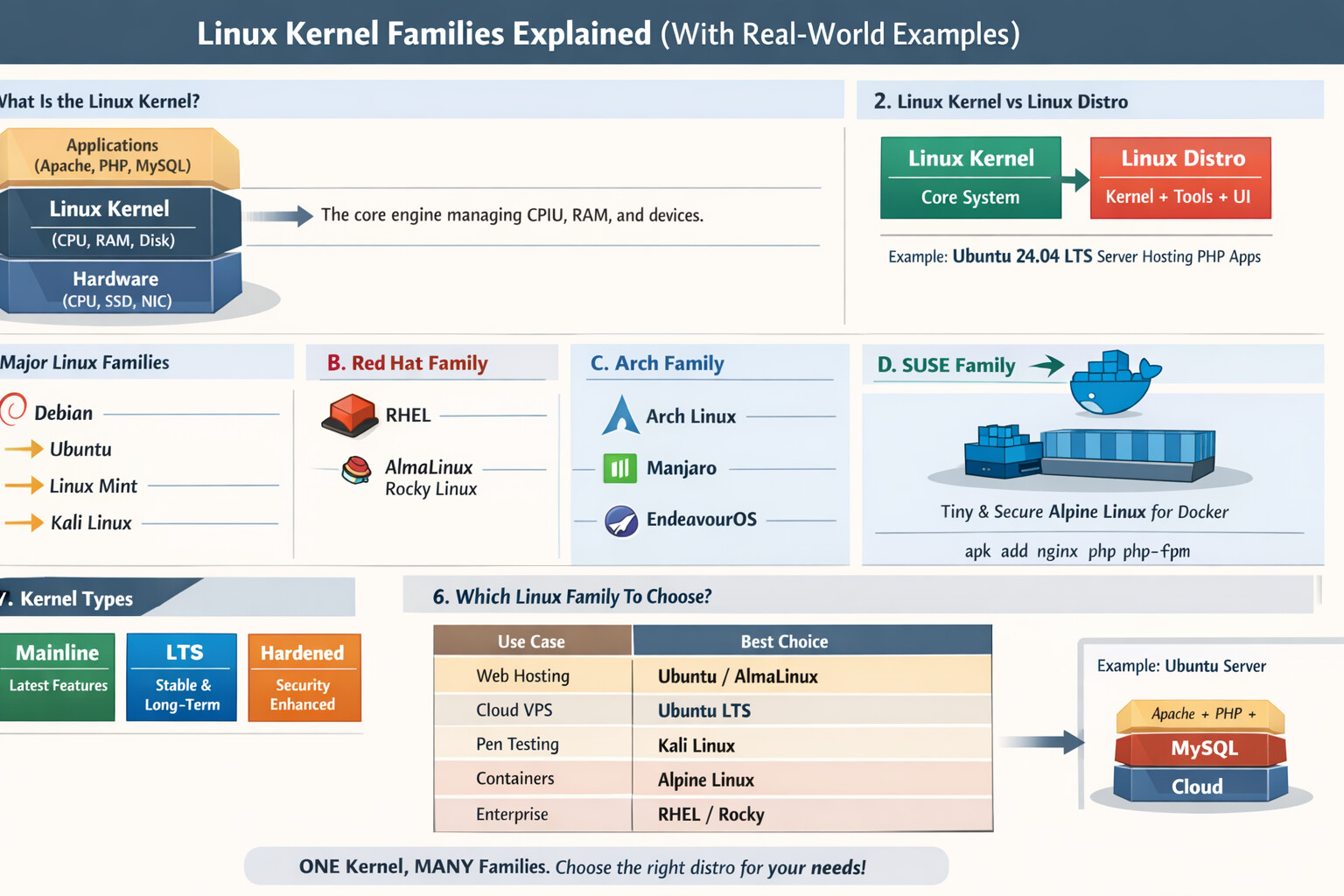
Linux Kernel Families Explained (With Real-World Examples)
1. What Is the Linux Kernel? (Foundation First)
The Linux Kernel is the core engine of a Linux operating system.
What the kernel does:
- Manages CPU processes
- Controls memory (RAM)
- Handles hardware drivers
- Manages file systems
- Enforces security & permissions
Simple Illustration
+------------------------+
|   Applications         |
|  (Apache, PHP, MySQL)  |
+------------------------+
|  User Space            |
|  (Shell, Libraries)    |
+------------------------+
|  Linux Kernel          |
|  (CPU, RAM, Disk)      |
+------------------------+
|  Hardware              |
|  (CPU, SSD, NIC)       |
+------------------------+
 One kernel, many operating systems
Ubuntu, Debian, Fedora, Arch — all run on the same Linux kernel, but with different tools and philosophies.
One kernel, many operating systems
Ubuntu, Debian, Fedora, Arch — all run on the same Linux kernel, but with different tools and philosophies.
2. Linux Kernel vs Linux Distributions
| Component | Meaning |
|---|---|
| Linux Kernel | Core system engine |
| Linux Distribution (Distro) | Kernel + tools + package manager + UI |
Example
- Kernel: Linux 6.6
- Distro: Ubuntu 24.04 LTS
- Use Case: Cloud server hosting PHP apps
3. Major Linux Kernel Families (Distribution Families)
Linux distributions are grouped into families, based on:
- Package manager
- Philosophy
- Base system
A. Debian Family (Most Popular for Servers)
Core Distributions
- Debian
- Ubuntu
- Linux Mint
- Kali Linux
- Pop!_OS
Illustration
Debian
 ├── Ubuntu
 │    ├── Ubuntu Server
 │    ├── Ubuntu Desktop
 │    └── Pop!_OS
 ├── Linux Mint
 └── Kali Linux
Package Manager
APT (.deb packages)
apt install apache2
Real-World Usage
| Distro | Usage |
|---|---|
| Debian | Stable web servers |
| Ubuntu Server | Cloud hosting, VPS |
| Kali Linux | Penetration testing |
| Linux Mint | Desktop users |
Example (Web Server)
sudo apt update
sudo apt install apache2 php mysql-server
Why Ubuntu is popular
- Strong LTS (Long Term Support)
- Massive community
- Used by AWS, Azure, Google Cloud
B. Red Hat Family (Enterprise & Corporate)
Core Distributions
- Red Hat Enterprise Linux (RHEL)
- CentOS Stream
- AlmaLinux
- Rocky Linux
- Fedora
Illustration
Fedora
  |
RHEL
  ├── AlmaLinux
  ├── Rocky Linux
  └── Oracle Linux
Package Manager
DNF / YUM (.rpm packages)
dnf install httpd php mysql-server
Real-World Usage
| Distro | Usage |
|---|---|
| RHEL | Banks, enterprises |
| AlmaLinux | cPanel servers |
| Rocky Linux | Hosting providers |
| Fedora | Developers, testers |
Example (Hosting Server)
dnf install httpd php-fpm mariadb-server
systemctl enable httpd
Why hosting companies use this family
- SELinux security
- Long-term stability
- cPanel & WHM support
C. Arch Family (Rolling Release)
Core Distributions
- Arch Linux
- Manjaro
- EndeavourOS
Illustration
Arch Linux
 ├── Manjaro
 └── EndeavourOS
Package Manager
pacman
pacman -S nginx php mariadb
Real-World Usage
| Distro | Usage |
|---|---|
| Arch Linux | Power users |
| Manjaro | Desktop devs |
특징 (Characteristics)
- Always latest kernel
- No LTS
- Manual configuration
Used by advanced Linux users, not ideal for production servers.
D. SUSE Family (Enterprise & SAP)
Core Distributions
- SUSE Linux Enterprise (SLES)
- openSUSE Leap
- openSUSE Tumbleweed
Illustration
openSUSE
 ├── Leap (Stable)
 └── Tumbleweed (Rolling)
Package Manager
zypper
zypper install apache2 php8 mariadb
Real-World Usage
- SAP environments
- Large enterprise data centers
E. Gentoo Family (Source-Based)
Core Distribution
- Gentoo
특징
- Compile everything from source
- Extreme performance tuning
Example
emerge nginx php mariadb
Used in:
- Embedded systems
- Performance-critical servers
F. Alpine Linux (Containers & Cloud)
Key Features
- Very small (≈5MB)
- Uses musl libc
- Security-focused
Package Manager
apk add nginx php php-fpm mariadb
Real-World Usage
- Docker containers
- Kubernetes pods
- CI/CD pipelines
Example
FROM alpine:latest
RUN apk add nginx php php-fpm
Most Docker images are Alpine-based
4. Linux Kernel Types (Advanced)
Kernel Variants
| Kernel Type | Usage |
|---|---|
| Mainline | Latest features |
| LTS | Servers & production |
| Hardened | Security |
| Real-Time (RT) | Industrial systems |
Example
uname -r
6.6.12-ubuntu-lts
5. Linux Kernel vs Windows Kernel
| Feature | Linux | Windows |
|---|---|---|
| Open Source |  |
 |
| Modular Kernel | |
|
| Server Stability | Very High | Medium |
| Customizable | Extreme | Limited |
Why Linux Dominates Servers
- Cloud-native
- Lightweight
- No licensing cost
- High automation
6. Which Linux Family Should You Choose?
Decision Table
| Use Case | Best Choice |
|---|---|
| Web Hosting | Ubuntu / AlmaLinux |
| Cloud VPS | Ubuntu LTS |
| Pen Testing | Kali Linux |
| Containers | Alpine |
| Desktop Beginner | Linux Mint |
| Enterprise | RHEL / Rocky |
7. Real-Time Example (Nestict Cloud Scenario)
Hosting a PHP App
Ubuntu 22.04 LTS
Linux Kernel 5.15
Apache + PHP 8.3 + MySQL
Stack Diagram
Client Browser
     |
   Nginx
     |
  PHP-FPM
     |
  MySQL
     |
 Linux Kernel
     |
 Cloud VM (SSD, CPU)
8. Key Takeaway
Linux has ONE kernel, but MANY families of operating systems built around it. Choosing the right family depends on stability, support, and use case.