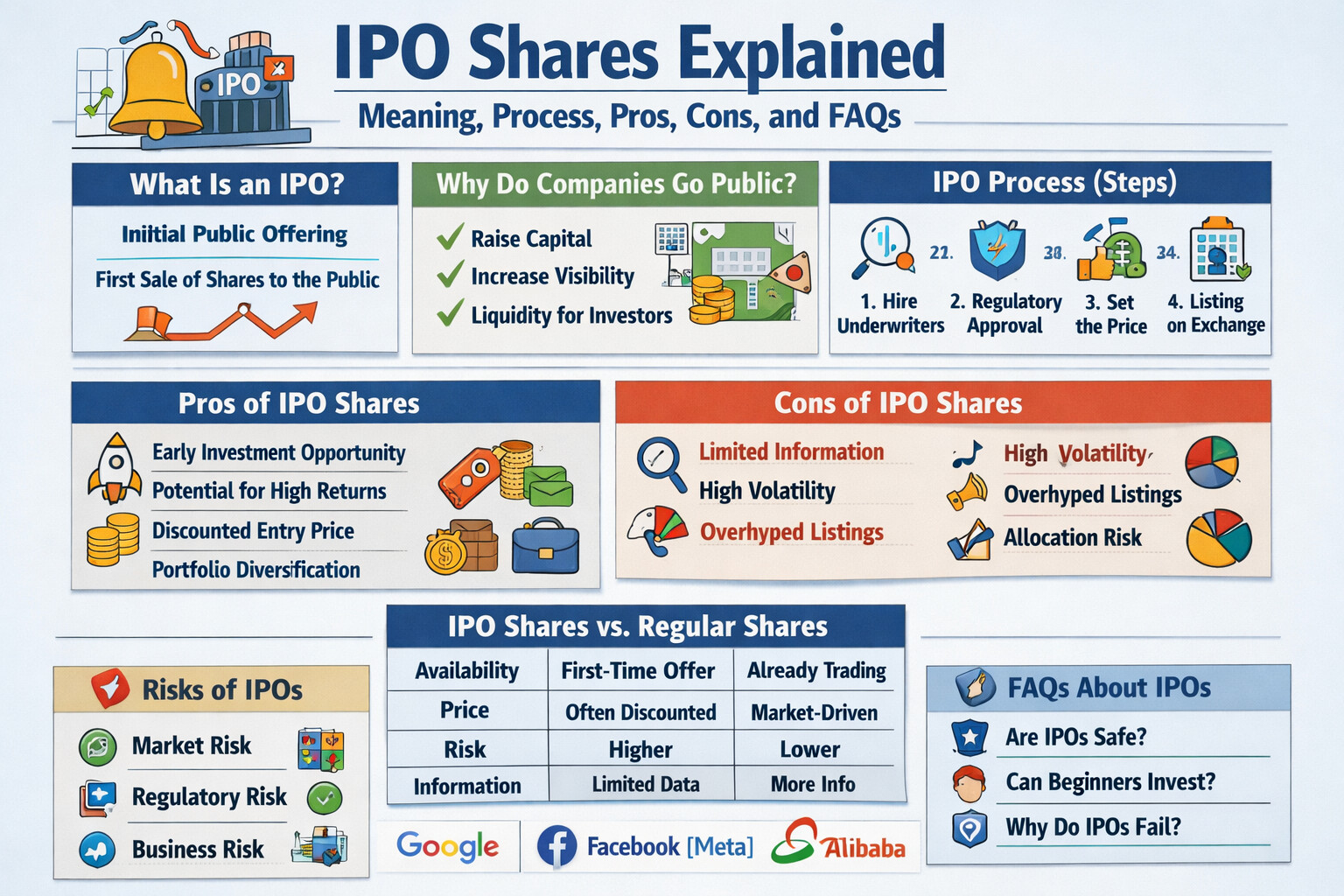
IPO Shares Explained: Meaning, Process, Pros, Cons, and FAQs
Table of Contents
- Introduction to IPO Shares
- What Does IPO Mean?
- What Are IPO Shares?
- Why Companies Go for an IPO
- How the IPO Process Works (Step-by-Step)
- Types of IPOs
- IPO Shares vs Regular (Listed) Shares
- Who Can Invest in IPO Shares?
- How IPO Share Pricing Works
- Advantages (Pros) of IPO Shares
- Disadvantages (Cons) of IPO Shares
- Risks Associated with IPO Investments
- IPO Performance: Short-Term vs Long-Term
- Famous IPO Examples
- IPO Shares in Emerging Markets (e.g., Africa & Kenya)
- Frequently Asked Questions (FAQs)
- Final Thoughts
1. Introduction to IPO Shares
An IPO (Initial Public Offering) is one of the most important events in a company’s life. It marks the moment when a private company opens its doors to the public and allows everyday investors to own a part of the business through IPO shares.
IPO shares can offer exciting opportunities—but they also come with risks. Understanding how IPOs work is crucial before investing.
2. What Does IPO Mean?
IPO stands for Initial Public Offering.
It is the first time a private company offers its shares to the public through a stock exchange such as:
- Nairobi Securities Exchange (NSE)
- New York Stock Exchange (NYSE)
- London Stock Exchange (LSE)
- NASDAQ
After an IPO, the company becomes a publicly traded company.
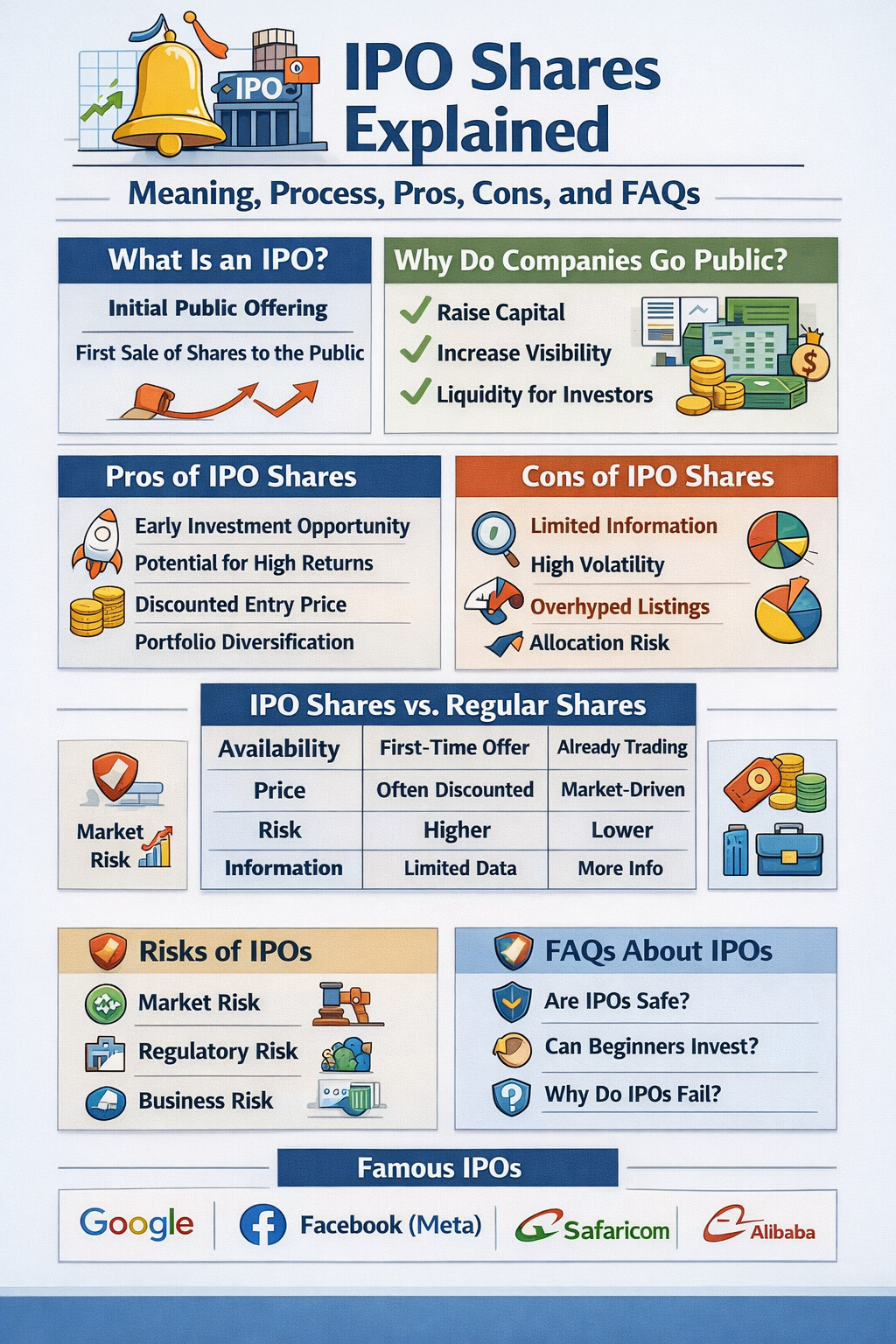
3. What Are IPO Shares?
IPO shares are:
- Shares offered to the public for the first time
- Sold before the company is officially listed on a stock exchange
- Usually offered at a fixed or price-range value
When you buy IPO shares, you become a part-owner (shareholder) of the company.
4. Why Companies Go for an IPO
Companies launch IPOs for several reasons:
1. Raise Capital
- Fund expansion
- Invest in technology
- Enter new markets
- Pay off debts
2. Increase Brand Visibility
- Public companies gain credibility
- Easier to attract customers and partners
3. Liquidity for Founders & Early Investors
- Allows early investors to sell their shares
- Converts private ownership into tradable assets
4. Employee Benefits
- Enables stock options and incentives
5. How the IPO Process Works (Step-by-Step)
Step 1: Hiring Advisors
The company hires:
- Investment banks (underwriters)
- Lawyers
- Auditors
Step 2: Due Diligence
- Financial records are audited
- Legal compliance is reviewed
Step 3: Regulatory Approval
- Prospectus is submitted to regulators (e.g., CMA in Kenya)
- Contains financials, risks, and business details
Step 4: Pricing the IPO
- Fixed price or price band is set
- Based on demand, company valuation, and market conditions
Step 5: Marketing (Roadshow)
- Company presents to institutional investors
- Gauges interest
Step 6: Subscription
- Investors apply for IPO shares
Step 7: Allotment
- Shares are allocated
- Oversubscription may lead to partial allotment
Step 8: Listing
- Shares begin trading on the stock exchange
6. Types of IPOs
1. Fixed Price IPO
- Price is decided in advance
- Simple and transparent
2. Book Building IPO
- Price range is provided
- Final price determined by demand
7. IPO Shares vs Regular (Listed) Shares
| Feature | IPO Shares | Regular Shares |
|---|---|---|
| Availability | First-time offer | Already trading |
| Price | Often discounted | Market-driven |
| Risk | Higher | Lower |
| Information | Limited history | More data available |
8. Who Can Invest in IPO Shares?
Retail Investors
- Individual investors
- Often get a reserved quota
Institutional Investors
- Banks, pension funds, mutual funds
High Net-Worth Individuals (HNIs)
- Large investments
9. How IPO Share Pricing Works
IPO pricing depends on:
- Company financials
- Industry trends
- Market conditions
- Investor demand
- Comparable companies
Underpricing is common to attract investors and ensure successful listing.
10. Advantages (Pros) of IPO Shares
1. Early Investment Opportunity
- Chance to invest before price discovery
2. Potential for High Returns
- Strong IPOs may list at a premium
3. Portfolio Diversification
- Exposure to new sectors and companies
4. Discounted Entry Price
- IPO prices may be lower than post-listing prices
5. Wealth Creation
- Long-term growth potential
11. Disadvantages (Cons) of IPO Shares
1. Limited Information
- No long trading history
2. High Volatility
- Prices can fluctuate sharply
3. Overhyped Listings
- Marketing may exaggerate prospects
4. Lock-In Periods
- Early investors may not sell immediately
5. Allocation Risk
- You may not get full allotment
12. Risks Associated with IPO Investments
- Market risk
- Business model risk
- Regulatory risk
- Management credibility risk
- Liquidity risk after listing
Important: Not all IPOs perform well.
13. IPO Performance: Short-Term vs Long-Term
Short-Term
- Listing day gains or losses
- Influenced by sentiment
Long-Term
-
Depends on:
- Revenue growth
- Profitability
- Management quality
- Industry trends
Long-term investors often benefit more than short-term traders.
14. Famous IPO Examples
Global
- Google (Alphabet)
- Facebook (Meta)
- Alibaba
- Saudi Aramco
Africa / Kenya
- Safaricom IPO (one of Africa’s largest)
- Equity Bank listing
- KCB Group
15. IPO Shares in Emerging Markets (Africa & Kenya)
In emerging markets:
- IPOs help deepen capital markets
- Encourage local ownership
- Support economic growth
Challenges include:
- Low investor awareness
- Market liquidity issues
- Regulatory delays
16. Frequently Asked Questions (FAQs)
Q1: Are IPO shares safe?
Not completely. They carry higher risk compared to established stocks.
Q2: Can beginners invest in IPOs?
Yes, but they should research thoroughly.
Q3: Why do some IPOs fail?
Poor fundamentals, overvaluation, weak governance.
Q4: Can IPO shares be sold immediately?
Yes, once listed (unless under lock-in restrictions).
Q5: Are IPOs always profitable?
No. Some IPOs list below their offer price.
Q6: How do I apply for IPO shares?
Through:
- Stockbrokers
- Banks
- Online trading platforms
17. Final Thoughts
IPO shares represent opportunity, innovation, and growth, but they also involve uncertainty and risk. Successful IPO investing requires:
- Research
- Patience
- Understanding the business model
- Awareness of market conditions
Golden Rule:
Do not invest in an IPO just because it is popular—invest because the business is strong.